🛍️ Products
❤️ Health
🌿 Wellness
💪 Performance
🤝 Relationships
🛍️ Products
❤️ Health
🌿 Wellness
💪 Performance
🤝 Relationships

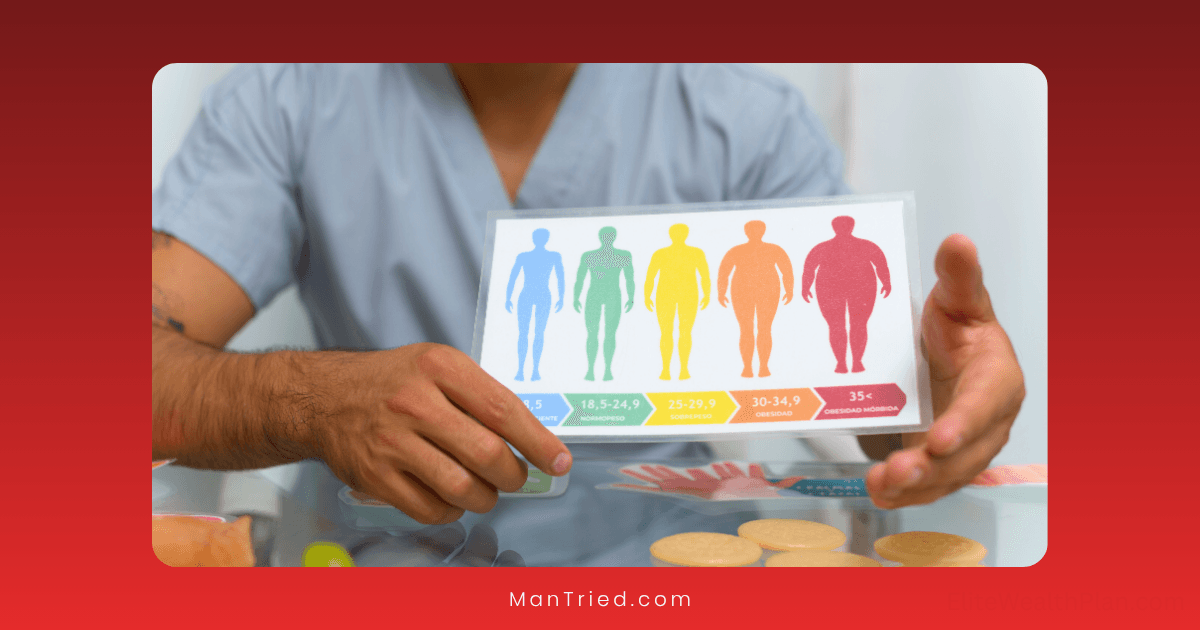
For decades, Body Mass Index (BMI) has reigned supreme as the go-to measurement for assessing health risks. However, when it comes to sexual health and function, this simple height-to-weight ratio falls woefully short. The truth is, your body’s composition—how your weight is distributed between muscle, fat, and where that fat is stored—tells a much more complete story about your sexual wellbeing.
Recent research reveals that specific body composition metrics can predict sexual function far more accurately than BMI alone. Let’s explore the measurements that truly matter and understand how they influence your hormones, blood flow, and ultimately, your sexual health.
BMI was never designed to assess individual health. Belgian mathematician Adolphe Quetelet developed it in the 1830s as a population-level statistical tool. Today, its limitations are well-documented:
As research published in Nature demonstrates, BMI alone misses crucial factors that directly impact sexual function. So what metrics should we be tracking instead?
Perhaps the most accessible and telling measurement is your waist-to-hip ratio—the circumference of your waist divided by the circumference of your hips.
Why it matters for sexual health:
How to measure it: Using a flexible tape measure, measure your waist at the narrowest point (usually at the navel) and your hips at their widest point. Divide the waist measurement by the hip measurement.
Unlike subcutaneous fat that you can pinch under your skin, visceral fat wraps around your internal organs. It’s metabolically active, producing hormones and inflammatory substances that directly impact sexual function.
Why it matters for sexual health:
According to Dr. Emin Özbek, a urologist specializing in sexual medicine, “Visceral fat, located around vital organs, poses a greater health risk than subcutaneous fat and is strongly associated with erectile dysfunction through multiple pathways including hormonal imbalances and vascular damage.”.
How to measure it: While the gold standard requires imaging (CT or MRI scans), you can use specialized scales with bioelectrical impedance analysis (BIA) technology or track your waist circumference as a proxy (over 40 inches for men or 35 inches for women indicates excess visceral fat).
This emerging metric provides valuable insights into metabolic health and hormonal balance by comparing muscle mass to visceral fat.
Why it matters for sexual health:
A study published in the National Library of Medicine found significant differences in SVR between sexes, with men exhibiting a strong positive association between SVR and overall health markers.
How to measure it: This typically requires professional body composition analysis through DEXA scans or advanced BIA devices available at some fitness centers and medical facilities.
Your metabolic age compares your Basal Metabolic Rate (BMR) to the average BMR of people your chronological age.
Why it matters for sexual health:
A study of men under 40 found that those with erectile dysfunction had a significantly higher metabolic age (44.63 ± 6.9 years) compared to those without ED (39.9 ± 8.59 years). This suggests that your body’s metabolic function—not just your chronological age—plays a crucial role in sexual health.
How to measure it: Many advanced body composition scales can calculate this, or you can have it measured at specialized health clinics.
Recent research has developed several new metrics that combine multiple measurements to better predict health outcomes, including sexual function:
A 2024 study in Nature Scientific Reports found that for each one-unit increase in ABSI, the odds of erectile dysfunction increased by 62.11%—a much stronger predictor than BMI alone.
Your body composition directly influences the hormones that drive sexual function:
Body composition affects sexual health through multiple pathways:
Sexual arousal depends on healthy blood flow to genital tissues. Excess visceral fat:
Sexual arousal and orgasm rely on complex neurological pathways that can be impaired by:
While physical mechanisms are important, psychological aspects of body composition also matter:
If your body composition metrics suggest room for improvement, consider these evidence-based approaches:
Muscle tissue is metabolically active and supports hormone balance:
Not all exercise equally affects visceral fat:
What you eat directly impacts body composition and sexual health:
Poor sleep disrupts hormones that regulate body composition:
Some supplements may support healthy body composition:
Michael, 47: “After years of struggling with ED, I learned my visceral fat level was 14 (healthy range is under 10). Through HIIT training and diet changes, I reduced it to 8 over six months. My testosterone increased naturally, and my erectile function improved dramatically—all without significant weight loss. My BMI only changed by 1 point, but my sexual health transformed completely.”
Sophia, 38: “I was always considered ‘skinny fat’—normal BMI but low muscle mass. After adding strength training and improving my SVR, my energy and libido increased significantly. My weight barely changed, but my body composition shifted dramatically, and so did my interest in sex.”
James, 52: “Reducing my waist-to-hip ratio from 1.02 to 0.94 coincided with a complete resolution of my ED issues. My doctor was amazed at how the changes in my body composition improved my vascular health markers. I wish I’d known years ago that it wasn’t about losing weight but changing where I carried it.”
When it comes to sexual health, what matters isn’t simply how much you weigh, but how your body composition is structured. By focusing on metrics like waist-to-hip ratio, visceral fat levels, and muscle mass rather than just BMI, you gain a much clearer picture of your metabolic health and potential sexual function.
Remember that improvements in these metrics often yield benefits long before significant weight changes occur. Many people experience enhanced sexual function with relatively modest improvements in body composition—particularly when visceral fat decreases and muscle mass increases.
If you’re concerned about sexual health issues, consider asking your healthcare provider about these more sophisticated measurements. They provide a more complete picture of your health and can guide more effective interventions than focusing on weight alone.
Have you noticed changes in your sexual health after improving your body composition? Share your experiences in the comments below.