🛍️ Products
❤️ Health
🌿 Wellness
💪 Performance
🤝 Relationships
🛍️ Products
❤️ Health
🌿 Wellness
💪 Performance
🤝 Relationships

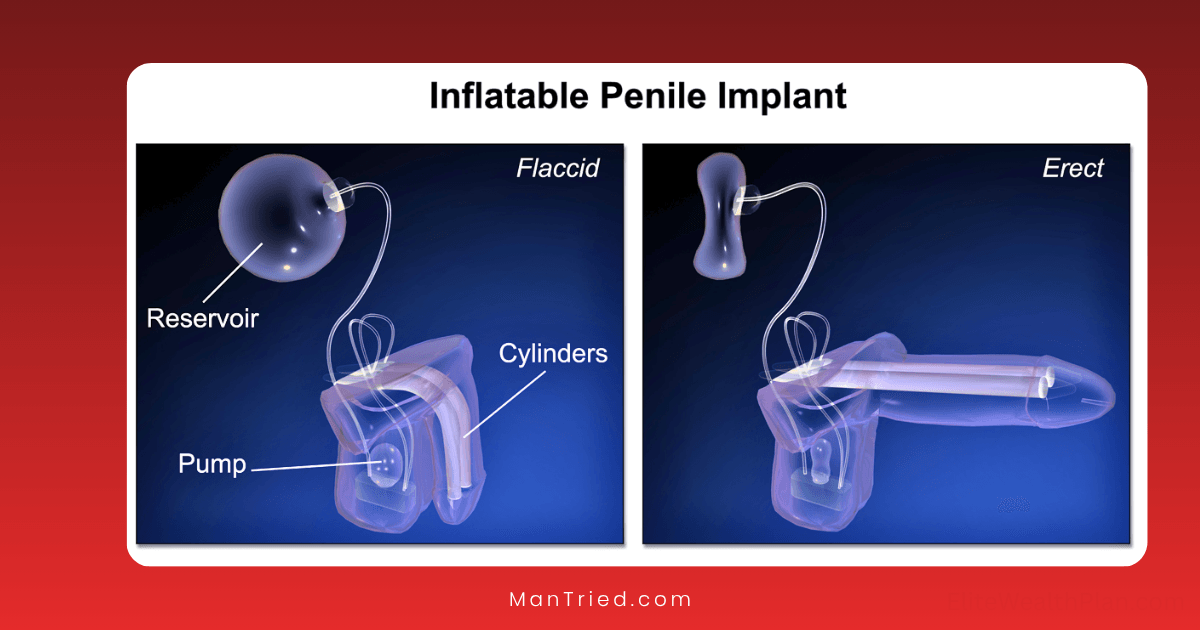
Erectile dysfunction (ED) affects millions of men worldwide, with projections suggesting over 322 million men will experience this condition by 2025. While first-line treatments like oral medications have revolutionized ED management, they aren’t effective for everyone. For men with severe ED who don’t respond to conservative approaches, penile implants represent the gold standard treatment—offering a reliable, on-demand solution with satisfaction rates exceeding 90%.
The field of penile implant technology has seen remarkable advancements in recent years, with innovations focused on improving reliability, reducing complications, enhancing user experience, and creating more natural results. This article explores the cutting-edge developments in penile implant technology and what the future may hold for this important treatment option.
Before diving into recent innovations, it’s helpful to understand how penile implants have evolved over time.
The modern era of penile implants began in the early 1970s with the introduction of the first inflatable penile prosthesis (IPP) by American Medical Systems (AMS). Since then, these devices have undergone numerous iterations and improvements.
“The basic concept of the three-piece inflatable penile prosthesis hasn’t changed dramatically since its introduction,” explains Dr. Ricardo Munarriz, Professor of Urology at Boston University School of Medicine. “However, the materials, mechanical reliability, and design features have been continuously refined to address complications and improve patient experience.”
Currently, there are three main categories of penile implants:
According to research published in the Journal of Sexual Medicine, three-piece inflatable devices are the most commonly used in the United States and other developed countries, accounting for approximately 75% of all implants.
The past decade has seen significant advancements in penile implant technology across several domains:
The Bioflex® material used in Coloplast’s Titan cylinders has increased tensile strength by seven times compared to earlier materials, resulting in significantly improved durability. According to a long-term study published in the Journal of Urology, 88% of Titan implants remained operational after 10 years.
Similarly, Boston Scientific (formerly AMS) has introduced Parylene Micro Coating for their 700 Series cylinders, which enhances durability by reducing wear on the silicone material.
The TENACIO™ Pump, recently introduced by Boston Scientific for the AMS 700™ Inflatable Penile Prosthesis, represents a significant advance in usability. According to Boston Scientific’s news release, this redesigned pump features:
Similarly, Coloplast’s “One-Touch Release” (OTR) pump allows patients to deflate the device with a single squeeze, significantly improving ease of use.
Infection remains one of the most serious potential complications of penile implant surgery. Recent innovations have dramatically reduced infection rates:
InhibiZone®, developed by AMS/Boston Scientific, incorporates rifampin and minocycline into the external surfaces of the implant. According to a multicenter clinical study published in the Journal of Urology, this technology reduced postoperative infections by 82.4% compared to non-coated implants.
Coloplast’s Titan features a hydrophilic coating that absorbs antibiotics when soaked in an antibiotic solution during surgery. This approach allows surgeons to customize the antibiotic coverage based on patient needs and local bacterial resistance patterns.
“These infection-reducing technologies represent one of the most significant advances in penile implant surgery,” notes Dr. Paul Perito, a urologist specializing in penile implants. “We’ve seen infection rates drop from historical levels of 2-3% to less than 1% in many high-volume centers.”
The AMS LGX® (Length and Girth eXpansion) model offers a unique bidirectional dacron sleeve that allows for expansion in both length and girth—up to 25% in each dimension. This provides a more natural erection and potentially better size restoration for patients who have experienced penile shortening due to conditions like Peyronie’s disease or prostatectomy.
Both major manufacturers now offer expanded cylinder size options to better accommodate different anatomies:
Dr. Rafael Carrion, Professor of Urology at USF Health, explains: “The expanded range of sizes allows for much better customization to individual patient anatomy, which translates to improved comfort and satisfaction.”
Coloplast’s Lock-out™ valve and Boston Scientific’s similar technology address the problem of auto-inflation—spontaneous filling of the cylinders during physical activity, which was a common complaint with earlier models.
These innovations minimize fluid transfer under abdominal pressure, significantly reducing episodes of embarrassing auto-inflation while maintaining proper function when intentionally activated.
Both manufacturers have developed reinforced, kink-resistant tubing that connects the components of three-piece implants. This seemingly simple improvement has significantly reduced mechanical failure rates by preventing tubing occlusion—previously a common cause of device malfunction.
The penile implant market continues to evolve, with several promising innovations on the horizon:
Researchers are exploring the integration of electronic components that would allow for:
While still primarily in development stages, these “smart implants” could represent the next major leap forward in the field.
Nickel-titanium alloys (Nitinol) and other shape memory materials are being investigated for use in penile implants. These materials could potentially allow for:
According to a review in the Journal of Sexual Medicine, the future may include custom-designed implants based on individual patient anatomy:
Perhaps the most futuristic approach involves tissue engineering and regenerative medicine:
Dr. Anthony Atala, Director of the Wake Forest Institute for Regenerative Medicine, notes: “While still experimental, the combination of tissue engineering with implant technology could eventually lead to hybrid solutions that offer the reliability of implants with more natural tissue integration.”
The global penile implant market is projected to reach $686 million by 2032, with a compound annual growth rate of 4.7%. However, access remains limited in many regions.
Future innovations are likely to include:
Despite technological advances, penile implants remain significantly underutilized. Less than 5% of eligible patients with refractory ED opt for implantation, often due to lack of awareness, cost concerns, or anxiety about the procedure.
Modern penile implants consistently demonstrate exceptional satisfaction rates:
A systematic review in the Journal of Sexual Medicine found that penile implants provided higher satisfaction rates than any other ED treatment, including oral medications, injections, or vacuum devices.
The cost of penile implant surgery varies significantly:
Many insurance plans, including Medicare, cover penile implants when medically necessary, though coverage policies vary widely.
Penile implant technology continues to advance rapidly, with innovations focused on improving reliability, reducing complications, enhancing user experience, and creating more natural results. For men with severe erectile dysfunction who don’t respond to other treatments, these devices offer a highly effective solution with exceptional satisfaction rates.
As awareness grows and technology continues to improve, penile implants are likely to become an increasingly important option in the management of erectile dysfunction. The future promises even more exciting developments that may further enhance this already successful treatment approach.